

This guide explains how railroad operators can access IIJA grants to implement rockfall monitoring technology, the eligibility requirements, and the compelling ROI data that strengthens funding applications.
What Is IIJA Funding for Railroad Safety Projects?
The Infrastructure Investment and Jobs Act, passed in 2021, established the PROTECT (Promoting Resilient Operations for Transformative, Efficient, and Cost-Saving Transportation) Discretionary Grant Program, administered by the Federal Highway Administration (FHWA). This programme provides over $1.4 billion across five years to enhance the resilience of surface transportation systems against natural hazards.
Q: What is IIJA funding for railroads?
A: The Infrastructure Investment and Jobs Act provides federal grant funding through the PROTECT programme for railroad infrastructure improvements, including monitoring systems that protect against rockslides, landslides, and extreme weather events.
PROTECT programme priorities include:
Transportation infrastructure resilience against natural hazards
Rockfall and landslide monitoring systems
Planning, design, construction, and implementation of hazard reduction measures
Real-time slope sensors and early warning systems
Ongoing monitoring infrastructure maintenance
Eligible applicants include states, local governments, and tribal entities. The programme evaluates and monitors projects to ensure effectiveness in hazard mitigation, with recipients required to collect and report on metrics established by the FHWA for evaluating project outcomes.
Does Rockfall Monitoring Qualify for IIJA Funding?
Rockfall monitoring systems explicitly qualify under multiple IIJA funding programmes that target transportation resilience and natural hazard mitigation.
Q: Does rockfall monitoring technology qualify for IIJA safety grants? A: Yes, rockfall monitoring systems are explicitly identified as eligible activities under the PROTECT Discretionary Grant Program and FEMA's BRIC programme, which specifically fund landslide, rockslide, and slope stabilisation projects.
IIJA funding programmes for rockfall monitoring include:
PROTECT Discretionary Grant Program:
Administered by the Federal Highway Administration (FHWA)
Four main categories: Planning Grants, Resilience Improvement Grants, Community Resilience and Evacuation Route Grants, and At-Risk Coastal Infrastructure Grants
Eligible activities include planning, monitoring, slope stabilisation, and installation of hazard warning technology
Explicitly covers rockfall and landslide monitoring systems
Building Resilient Infrastructure and Communities (BRIC) Program:
Managed by FEMA
Funds state, local, tribal, and territorial governments for hazard mitigation projects
Rockfall monitoring eligible when supporting hazard reduction or transportation protection
Often paired with engineering studies and slope stabilisation work
Annual cycles and competitive selection typical
Safeguarding Tomorrow through Ongoing Risk Mitigation (STORM) Program:
Also authorised through IIJA and run by FEMA
Provides capitalisation grants to states and tribes for hazard mitigation revolving loan funds
Can support rockfall mitigation, including monitoring
These programmes enable funding for installation of monitoring sensors, data systems, and associated mitigation efforts, as long as projects advance transportation resilience and public safety.
What Are the Eligibility Requirements for IIJA Railroad Safety Grants?
IIJA funding programmes have specific eligibility criteria based on the programme selected and the type of applicant organisation.
Q: Who is eligible to apply for IIJA railroad safety funding?
A: States, local governments, tribal entities, and territorial governments can apply for PROTECT and BRIC grants for rockfall monitoring projects that enhance transportation infrastructure resilience.
Key eligibility requirements include:
Applicant Qualification:
States and state departments of transportation
Local governments and metropolitan planning organisations
Tribal entities
Territorial governments
Public entities with transportation infrastructure responsibilities
Project Qualification:
Must improve transportation infrastructure resilience against natural hazards
Must address rockslides, landslides, or slope stability issues
Can include planning, design, construction, and implementation phases
Must support transportation system resilience and public safety outcomes
Eligible Activities Under PROTECT:
Installation and operation of advanced rockfall and landslide monitoring systems
Real-time slope sensors and early warning systems
Geotechnical investigations to determine risk levels
Implementation of mitigation methods (mesh nets, barriers, reinforcement, drainage enhancement)
Monitoring infrastructure maintenance
Hazard warning technology installation
Application Requirements:
Demonstration of transportation resilience improvement
Clear connection to natural hazard mitigation
Metrics collection and reporting framework for FHWA evaluation
Cost-benefit analysis showing project effectiveness
Compliance with federal procurement requirements
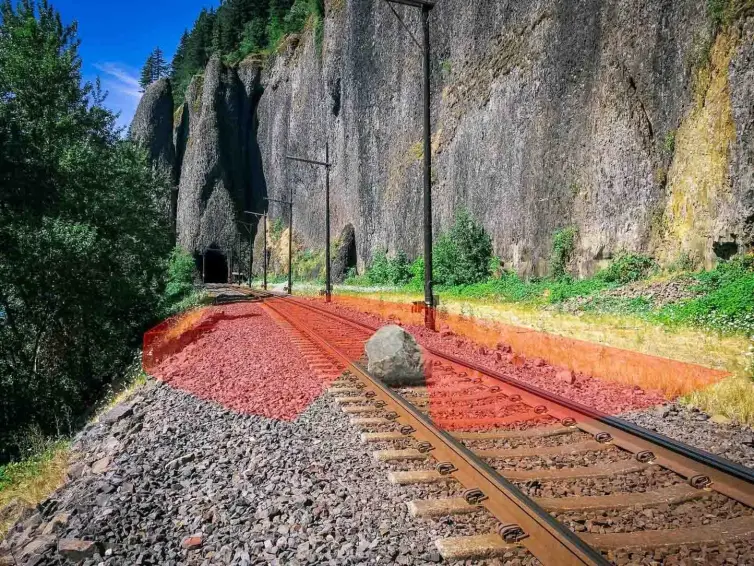 Rockfall hazard on railway track - A large boulder blocks the railway line beneath towering rock faces, demonstrating the critical safety risks that advanced LiDAR rockfall monitoring systems are designed to detect and prevent.
How Does Rockfall Monitoring Meet Buy America Requirements?
Buy America compliance is a critical requirement for IIJA funding eligibility, ensuring federal grants support domestic manufacturing.
Q: Is L.B. Foster's rockfall monitoring system Buy America compliant?
A: Yes, the system is manufactured in Dublin, Ohio and has been used with federal funding on previous installations, meeting Buy America compliance requirements.
Buy America compliance details:
Manufacturing location: Dublin, Ohio, United States
Previous federal funding: Successfully used with federally funded installations
Component sourcing: Meets domestic content requirements
Documentation available: Complete Buy America certification provided
Compliance verification: Can be independently verified for grant applications
The system's domestic production eliminates the most common obstacle to IIJA funding approval, streamlining the application process for railroad operators.
What Is the ROI That Justifies IIJA Funding Applications?
Compelling return on investment data strengthens IIJA funding applications by demonstrating fiscal responsibility and operational benefits.
Q: What cost savings justify IIJA funding applications for rockfall monitoring?
A: Railroads save £642,000 annually in labour costs alone, with additional capacity gains of 2-3 trains per day and 99.8% reduction in false alarms compared to traditional slide fences.
Metric |
Traditional Slide Fence |
Rockfall Monitoring |
|---|---|---|
Annual labour costs |
$728,000 |
$86,000 |
False alarm rate |
99.5% |
0.2% |
Slow order time (annual) |
5,500 hours |
11 hours |
Trains delayed |
63.4% |
13% |
Missed valid events |
2 out of 3 (66.7%) |
0 out of 3 (0%) |
Capacity increase |
Baseline |
2-3 trains daily |
Additional ROI factors:
Seven-year operational history without missing a rockfall event
Automatic system reset (no manual fence repair required)
Reduced emergency callout costs (no fall protection or bucket trucks needed)
Network capacity gains worth millions annually
Enhanced safety record for regulatory compliance
One Class 1 railroad operating a single subdivision with slide fences experienced over 5,500 activations annually, with only 0.5% being valid events. This resulted in over £100 million in operational costs when accounting for labour and delays.
How Can Railroads Apply for IIJA Funding for Rockfall Monitoring?
The IIJA funding application process varies by programme, with PROTECT and BRIC following specific timelines and documentation requirements.
Q: What documentation do railroads need to apply for IIJA funding? A: Applications require a detailed project proposal demonstrating transportation resilience improvement, geotechnical investigation data, cost-benefit analysis, hazard mitigation justification, technical specifications for monitoring systems, and metrics collection framework for FHWA evaluation.
PROTECT Discretionary Grant Application Process:
Determine grant category: Select from Planning Grants, Resilience Improvement Grants, Community Resilience and Evacuation Route Grants, or At-Risk Coastal Infrastructure Grants
Conduct geotechnical assessment: Document rockfall risk levels and current vulnerabilities
Gather incident data: Compile historical data on rockfall events, slide fence failures, and transportation delays
Develop resilience case: Demonstrate how monitoring improves transportation infrastructure resilience against natural hazards
Create metrics framework: Establish how project outcomes will be measured and reported to FHWA
Obtain technical specifications: Work with monitoring system providers to develop detailed design
Complete application package: Submit through grants.gov by programme deadline
FHWA evaluation: Respond to additional questions during competitive selection process
BRIC Program Application Process:
Coordinate with state/tribal hazard mitigation office: BRIC applications typically flow through state entities
Demonstrate hazard reduction: Show how rockfall monitoring reduces natural hazard risks
Link to transportation protection: Establish clear connection to transportation infrastructure safety
Pair with engineering work: Consider combining monitoring with slope stabilisation studies
Annual cycle submission: Submit during FEMA's annual competitive grant cycle
Required Documentation Checklist:
Project narrative explaining transportation resilience improvement
Geotechnical investigation demonstrating rockfall hazard
Detailed budget with monitoring system cost breakdown
Historical incident reports showing rockfall frequency and impacts
Technical specifications for real-time monitoring sensors and alerting systems
Metrics collection and reporting plan for FHWA evaluation
Cost-benefit analysis demonstrating hazard mitigation effectiveness
Implementation timeline with clear milestones
Letters of support from transportation stakeholders
Environmental review documentation (if applicable)
Recent Funding Examples: Recent PROTECT funding announcements indicate tens of millions of dollars directed to roadway protection projects, which may encompass rockfall monitoring technology in at-risk areas. Pilot projects and advanced sensor systems are eligible if integrated into larger surface transportation resiliency efforts.
L.B. Foster provides application support including site surveys, geotechnical assessment collaboration, technical documentation, ROI calculations, and metrics framework development to assist applicants throughout the IIJA grant application process.
What Makes Rockfall Monitoring a Strong IIJA Funding Candidate?
Rockfall monitoring addresses multiple PROTECT and BRIC programme priorities simultaneously, making it a competitive grant application under IIJA funding criteria.
Q: Why do rockfall monitoring projects receive favourable IIJA funding consideration?
A: These projects explicitly address transportation infrastructure resilience against natural hazards (rockslides and landslides), which are specifically identified as eligible activities under PROTECT programme guidelines, whilst delivering measurable capacity and safety improvements.
PROTECT Programme Alignment:
Natural hazard resilience: Directly addresses rockslides and landslides identified in programme guidelines
Transportation infrastructure protection: Prevents derailments and service disruptions
Real-time monitoring capability: Provides early warning systems explicitly mentioned as eligible activities
Planning through implementation: Covers full project lifecycle from geotechnical investigation to operational monitoring
Measurable outcomes: Delivers quantifiable metrics for FHWA evaluation (99.8% false alarm reduction, 2-3 additional trains daily)
BRIC Programme Alignment:
Hazard mitigation focus: Reduces rockfall hazards threatening transportation corridors
Engineering integration: Pairs naturally with slope stabilisation and geotechnical studies
Community resilience: Protects critical transportation routes supporting economic activity
State/tribal coordination: Fits within existing hazard mitigation planning frameworks
Competitive Advantages:
Proven technology: Seven-year operational history without missed rockfall events
Scalability: Can start with pilot project and expand to multiple sites
Integration capability: Compatible with existing transportation management systems
Advanced sensor technology: Real-time slope monitoring aligns with PROTECT's focus on modern early warning systems
Economic and Operational Benefits:
Documented £642,000 annual labour savings compared to traditional slide fences
Capacity increases of 2-3 trains daily on protected corridors
99.8% reduction in false alarms versus conventional detection methods
Automatic system reset eliminates expensive emergency callouts
Environmental benefits through reduced fuel waste from unnecessary slow orders
Recent PROTECT funding announcements demonstrate that tens of millions of dollars are being directed to roadway and railway protection projects in at-risk areas, with pilot projects and advanced alerting platforms explicitly eligible when integrated into larger transportation resiliency efforts.
Summary
IIJA federal funding through the PROTECT Discretionary Grant Program provides over $1.4 billion across five years for transportation infrastructure resilience projects, with rockfall and landslide monitoring explicitly identified as eligible activities.
States, local governments, and tribal entities can access these grants for installing real-time monitoring sensors, early warning systems, and hazard mitigation measures.
L.B. Foster's rockfall monitoring system delivers documented ROI including £642,000 in annual labour savings and 2-3 additional trains per day, whilst meeting PROTECT programme requirements for transportation resilience and public safety outcomes.
Applicants should focus on the PROTECT Discretionary Grant Program administered by FHWA or FEMA's BRIC programme, both of which specifically fund rockslide, landslide, and slope stabilisation projects with annual competitive selection cycles.